
If You Want Your Kid to Be the Next Google CEO, Buy a Home Near Nature. Here's the Science!
- David Cutler
- May 28
- 8 min read

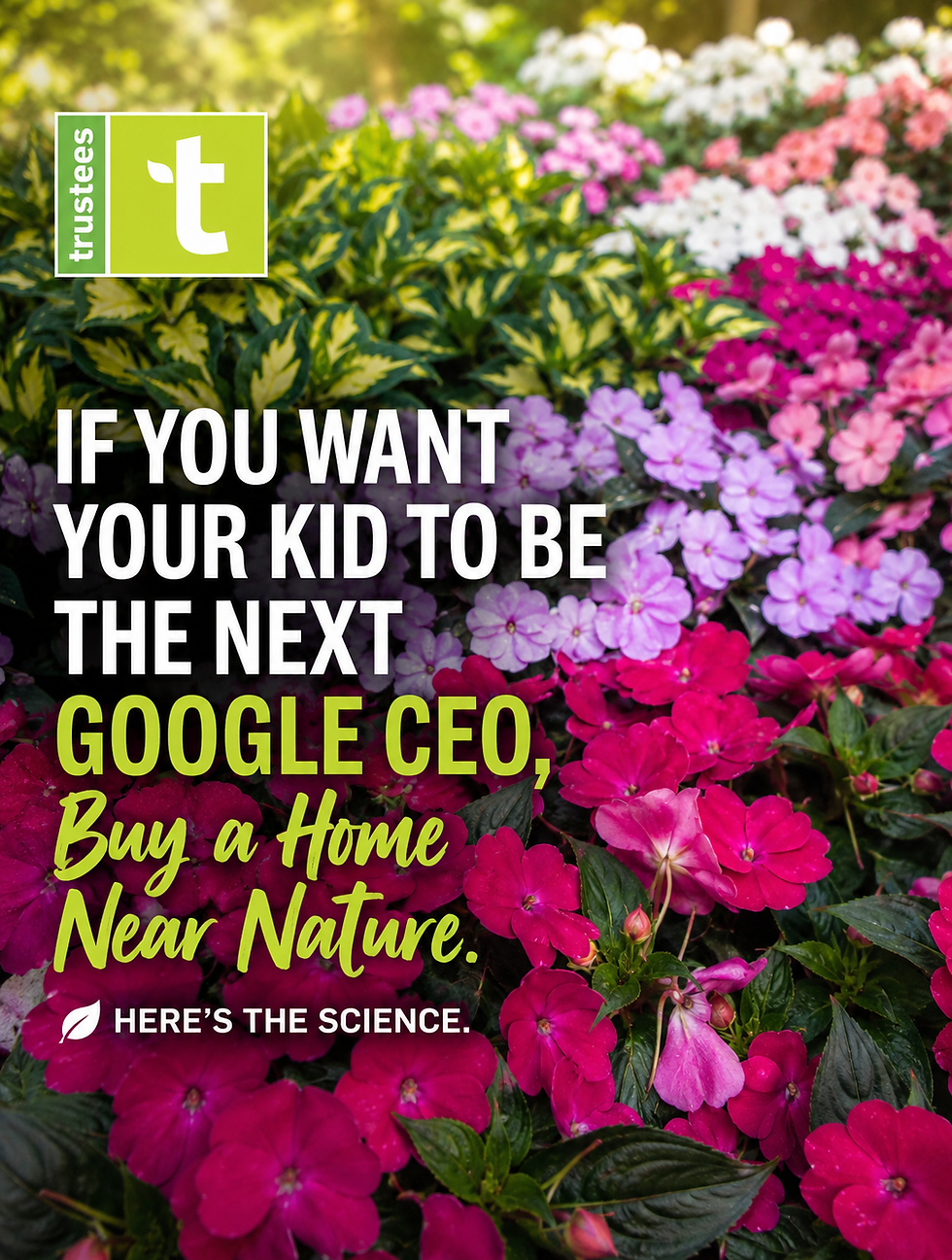
Is where you buy your home actually shaping who your child becomes? The science says yes, and it might be the most important factor most South Shore homebuyers aren't thinking about.
I recently attended a presentation by The Trustees (thetrustees.org), the oldest land conservation nonprofit of its kind in the world, founded right here in Massachusetts in 1891. Their President and CEO, Katie Theoharides, walked through data that stopped me in my tracks. Not just as a real estate agent, but as someone who thinks deeply about where people choose to build their lives.
Who Is The Trustees?
The Trustees is Massachusetts' largest and the nation's first land conservation and preservation nonprofit. Their mission is straightforward: protect and share the special places of Massachusetts so they can be enjoyed for generations to come. Today they steward more than 120 properties across 27,000 acres, all open to the public. World's End in Hingham. The Norris Reservation in Norwell. The Governor Oliver Ames Estate in Easton. Chances are, they're already protecting something in your town.
What Living Near Nature Actually Does to Your Kids
The research Katie shared wasn't anecdotal. Children who grow up with regular access to green space and natural environments show measurably lower rates of depression and anxiety. They develop stronger executive cognition, the brain's command center for focus, decision-making, and problem-solving. The same skills that put people in corner offices. The same skills that built Google, Apple, and every other company you've ever admired from a distance.
We spend a lot of time debating school districts, commute times, and square footage when we buy a home. Proximity to nature rarely makes the list, even though the evidence suggests it should be near the top.
The next Google CEO might already be growing up on the South Shore. The question is whether the land that shapes them will still be there.
Your Home Is Worth More Near Conservation Land. Full Stop.
Homes adjacent to conservation land, parks, and open space consistently command a premium. And unlike a renovated kitchen or a finished basement, that value isn't going anywhere.
Conservation land is permanent. It can't be subdivided and sold to a developer next decade. That permanence is exactly what The Trustees protects, and exactly what the market rewards.
If you're house hunting on the South Shore, proximity to protected open space belongs on your checklist right alongside school ratings and lot size. It's not a lifestyle bonus. It's a financial variable.
The Land Transition No One Is Talking About
Here's the part of Katie's presentation that really hit home.
Over 50% of Massachusetts farmers are over the age of 50. The average Massachusetts farmer is somewhere between 60 and 65 years old. And unlike previous generations, there aren't younger farmers lined up to take over.
What happens to that land?
In the past, The Trustees often received conservation land through gifts and donations. Farmers who'd spent a lifetime building a relationship with the land wanted to see it protected, not developed. Some still feel that way, and that's genuinely encouraging.
But increasingly, The Trustees find themselves competing directly against developers and buyers on the open market, bidding on farms, golf courses, and even college campuses before they're lost forever.
The ratio Katie shared was striking: for every $1 spent sustaining natural land, roughly $30 is spent demolishing it. That's the economic reality of conservation today.

The South Shore's Hidden Real Estate Advantage — It's Already In Your Backyard
You don't have to look far to see what The Trustees protects and what it does to the neighborhoods around it.
Hingham sits at the center of it all. World's End is a 400-acre peninsula with Olmsted-designed carriage paths, rolling hills, and sweeping views of Boston Harbor, permanently protected since 1967. It cannot be subdivided. It cannot be developed. The homes around it reflect exactly that. Weir River Farm and Whitney & Thayer Woods add another layer, with 10 miles of trails through hardwood forests and open fields that back up to some of the most desirable addresses on the South Shore.
Norwell has the Norris Reservation, cart paths winding along the North River where shipbuilders were working within 30 years of the Pilgrims landing just down the coast. The timber from these very woods helped build the Beaver, the ship of Boston Tea Party fame. That history didn't disappear. The Trustees made sure of it.
Plymouth has Holmes Reservation, a former Revolutionary War Muster Ground and now a quiet oasis of protected open space in one of the fastest-growing towns in Massachusetts. Plymouth is expanding fast. The land that's protected today is the land that holds its character tomorrow.
Easton has the Governor Oliver Ames Estate, 36 acres of rolling meadows, garden ponds, and centuries-old specimen trees, free and open to the public year-round. The estate sits at the heart of the North Easton National Historic District, where the Ames family shaped an entire community. Their shovel company supplied tools for the Civil War and the construction of the Transcontinental Railroad. The Trustees was actually founded in the Boston offices of Frederick Lothrop Ames, a cousin of the Governor. The organization's roots and this property's roots are one and the same.
Canton has the Eleanor Cabot Bradley Estate, 90 acres of trails, open fields, and woodlands, free and open daily. One of the quieter gems in the Trustees portfolio and one of the closest to Avon, Stoughton, and the towns at the center of the South Shore market.
All of these places are permanent. None of them can be sold to a developer. None of them can be subdivided. And every single one of them directly affects the value, character, and livability of the neighborhood around them.
The child who grows up exploring these places, who learns to read a trail, who builds a relationship with the outdoors, who develops the patience and focus that nature demands, that child has an advantage. The research says so. The market says so.
What's Happening Right Now — And Why It Matters for Your Family
The research on nature and child development isn't a theory anymore. It's showing up in real estate decisions, in state policy, and in the news this week.
An 800-Acre College Campus Just Went Up for Sale. The Trustees Is Trying to Save It.
This is exactly what Katie Theoharides was describing at the podium. Hampshire College just put its entire 800-acre campus up for sale this week, following the announcement that it will close permanently at the end of 2026. Eight hundred acres of forests, farmland, trails, and open space sitting on the open market right now.
The Trustees and Kestrel Land Trust have already submitted a proposal to permanently protect the forests, fields, wildlife habitats, and farmland on that campus before it disappears to development.
Think about that. The child who grows up hiking those trails, learning to identify trees, building forts in those woods, that's the child who develops the focus, the creativity, and the executive cognition that puts people in corner offices. The child who grows up without that connection doesn't get the same foundation.
The Trustees is fighting to make sure that land stays available. But they need resources to do it.
Massachusetts Voters Have a Chance to Change the Equation in November
Right now, a coalition of more than 100 conservation organizations, including The Trustees, is working to put a landmark measure on the November 2026 ballot that would fundamentally change how Massachusetts funds land conservation.
The Protect Water and Nature Initiative would dedicate funds from the existing state sales tax on sporting goods, including golf clubs, camping gear, and fishing equipment, to generate $100 million every year for conservation without raising taxes.
One hundred million dollars a year. For protecting the places that make Massachusetts worth living in.
To get it on the ballot, supporters need to collect 21,000 more signatures before June 14th. That's two and a half weeks from today.
If you want your child to grow up near nature, near trails, open fields, and protected coastline, this is one of the most direct things you can do right now. Find a signature location at natureforma.org.
The Trustees Is Growing — But They Need Your Town
The Trustees' strategic plan for 2025 through 2030 sets an ambitious goal: protect significantly more of Massachusetts' irreplaceable land so it can be enjoyed for generations to come. They are actively acquiring farms, open fields, and college campuses right now, competing against developers on the open market every single day.
World's End doesn't fund itself. The Norris Reservation doesn't steward itself. Every trail you've walked, every field your kids have run through, every coastline view that made you fall in love with the South Shore, someone is paying to protect that.
That someone can be you.
How to Get Involved
The Trustees doesn't receive a dedicated government budget. The open spaces you walk through, the farms being preserved, the coastline that can't be developed, all of it is sustained primarily by people who choose to support it.
Here are several straightforward ways to get involved:
Become a Member
Membership starts at $60/year for an individual or $80/year for a family. You get free or reduced admission to more than 120 properties across Massachusetts, discounts on programs and events, advance ticketing, and a subscription to their quarterly Special Places magazine. More importantly, your membership directly funds their ability to protect land.
Join at thetrustees.org/membership
Make a Direct Donation
A direct donation goes straight toward land acquisition and stewardship, including the active bids happening right now against developers across the state.
Donate at thetrustees.org under Support Us.
Volunteer
The Trustees welcomes volunteers at properties across the state for trail maintenance, events, education programs, and more. If you love the outdoors and want to give back locally, this is a tangible way to do it.
Sign up at volunteer.thetrustees.org
Own Land? You May Have More Options Than You Think
When you give land to The Trustees, your donation may provide significant income tax, estate tax, and capital gains tax benefits. You can give land during your lifetime or leave it through your will, and you can donate an entire property, a smaller portion, or even a Conservation Restriction.
The state's conservation land tax credit offers a 50% tax credit on donated land value up to $75,000. Since 2011 it has conserved over 15,500 acres of privately owned land, leveraging $4.20 of land value for every $1 invested by the state.
If you're a landowner thinking about the future of your property, it's worth a conversation. Call The Trustees at 978.840.4446 or visit thetrustees.org.
The Bottom Line
The places that make the South Shore special, the trails, the coastline, the farms, the open fields, don't protect themselves. The Trustees has been doing it since 1891. And the research is now telling us that those places don't just make our towns beautiful. They shape the minds of the children who grow up near them.
A $60 membership is the most direct investment you can make in the neighborhood your children are growing up in. Signing a petition before June 14th costs nothing but five minutes of your time.
The next Google CEO is out there somewhere, growing up near a trail, a field, or a stretch of coastline that someone fought to protect.
Make sure it's your backyard.

David Cutler is a real estate agent with William Raveis, serving Hingham, Norwell, Plymouth, Easton, Canton, and the South Shore of Massachusetts. If you have questions about what's happening in your local market, reach out anytime.


Comments